

When comparing Christmas stamp sheets, booklets, and mixed packs, separate three questions: how the stamps are physically packaged, how many stamps the order contains, and whether the order includes one issue or several. A large quantity option answers the count question; it does not by itself tell you the packaging or design allocation.
Use this guide to compare listings in the Christmas stamp collection without confusing a photograph, a postal issue format, and a retailer's order label.
Sheet or pane, booklet, and mixed pack are not interchangeable
A sheet or pane describes an arrangement of stamps together. A booklet is a compact unit whose layout may put stamps on more than one side. The count and layout belong to the particular issue, so do not apply one issue's packaging to another. A product photo showing both sides is not necessarily two separate booklets.
A mixed pack describes a retailer's combination. It might include several issues and more than one physical format. The phrase does not establish a USPS-issued mixed product, a fixed list of designs, or a particular number of complete booklets.
| Label | What it helps describe | What still needs confirmation |
|---|---|---|
| Sheet or pane | The stamps' physical arrangement | Issue, count per unit, complete or partial unit, and total order count |
| Booklet | The booklet format of a particular issue | Stamps per booklet and number of booklets delivered |
| Mixed pack | A seller's combination of issues or styles | Named issues, counts per issue, allocation, and physical formats |
Read the total count and the units separately
For an issue supplied in booklets of 20, five complete booklets contain 100 stamps. Ten contain 200. These are examples for that format, not a rule that every booklet or sheet contains 20.
The 2016 Nativity listing includes a selection labeled five booklets / 100 stamps. Its original format is documented by the USPS Nativity announcement. Compare both the selected total and the delivered units when reviewing an order.
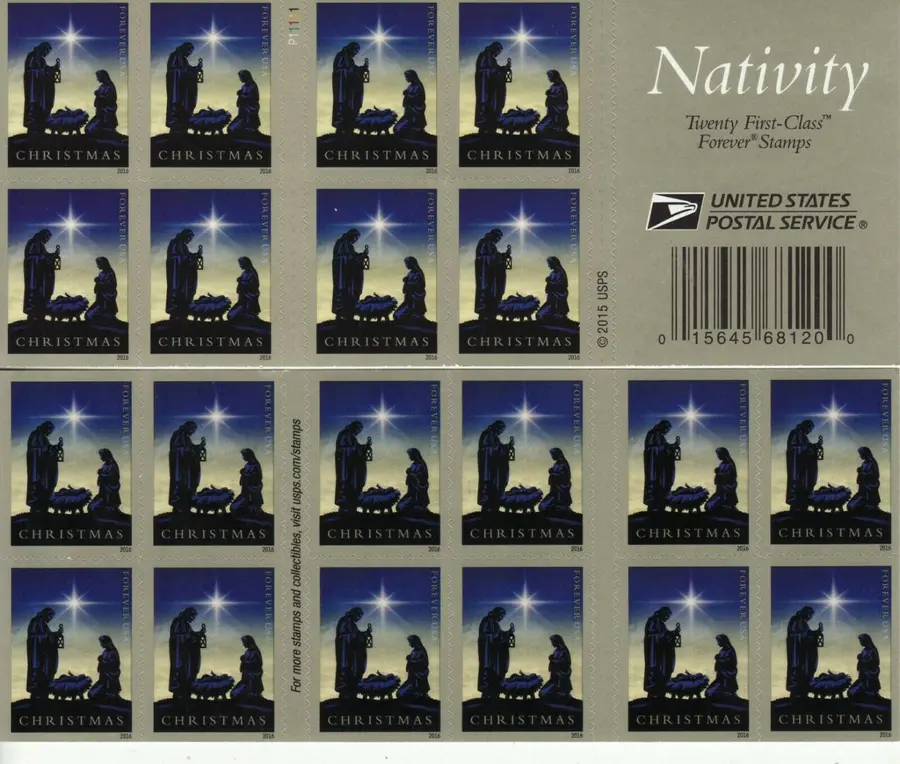
A quantity of 100 does not mean a single sheet of 100. Nor does a photo of one booklet prove that the order includes only one booklet. Keep the total stamp count as one line and the number of physical units as another.
| Complete booklets | Stamps per booklet | Total stamps |
|---|---|---|
| 5 | 20 | 100 |
| 10 | 20 | 200 |
| 15 | 20 | 300 |
| 25 | 20 | 500 |
This table is conditional arithmetic, not a warehouse inspection or a promise of the format in your shipment. If a seller supplies partial units or loose stamps, the total may be the same while the physical units differ. Confirm that arrangement before paying when complete booklets matter to you.
What to do if a listing says sheets but the issue was a booklet
Do not assume the difference has been resolved by the order label. Ask which physical format will be delivered and request a clear current photograph. It may be necessary to clarify the listing terminology or the units included. A format mismatch is a reason to verify details, not evidence on its own that an item is authentic or counterfeit.
Before paying, you should be able to describe the order plainly: the named issue, the total stamps, whether the units are complete, and the form in which they arrive. If you cannot do that from the page, use ToolStamps customer support rather than filling the gaps with assumptions.
Single-issue orders versus mixed packs
A single-issue order makes the visual plan easier to manage if you want every envelope to use the same general artwork. Some issues themselves contain several designs, so single issue does not always mean one identical image.
A mixed pack can suit a mailing where you welcome variety and can use all the included issues. It is less suitable when the project depends on a particular religious image, a specific Santa scene, or exact matching colors for each recipient group.
Before choosing a mixed pack, ask for the named issues, allocation of stamps to each issue, and whether substitutions are permitted. If it is described as a blind box, do not treat a representative photograph as a promise of the exact contents. Check any choice or return terms before purchasing.
Record both the total and the design split in your order notes. A hypothetical 100-stamp combination could contain 60 of one issue and 40 of another, but that is not a ToolStamps offer or a promised 50/50 split. If a particular design is essential, obtain the seller's confirmation rather than relying on a collage. The Christmas stamp design comparison helps with artwork choices after the actual issues are known.
Compare the complete order cost, including applicable shipping and taxes, with the number of usable stamps for your project. A lower displayed pack price is not automatically a lower total cost. A retailer's price is not the postal value of the stamps, and buying a larger retail pack does not by itself qualify your cards for USPS commercial mailing prices.
Translate the mailing list into a quantity, not a packaging guess
Count the planned envelopes and any explained reserve, then account for usable stamps already on hand. Do that before choosing a large option. In a simplified batch still needing 185 base stamps after those adjustments, an order of 200 leaves 15; choosing 500 instead would leave 315. The 185 already includes the chosen reserve, so do not add it again. Whether the leftovers are useful depends on your later mail, not the size of the pack's photograph.
Use the holiday-card quantity worksheet for the count calculation. Keep any required extra postage separate from the number of domestic base stamps; these examples do not establish that every card needs exactly one stamp.
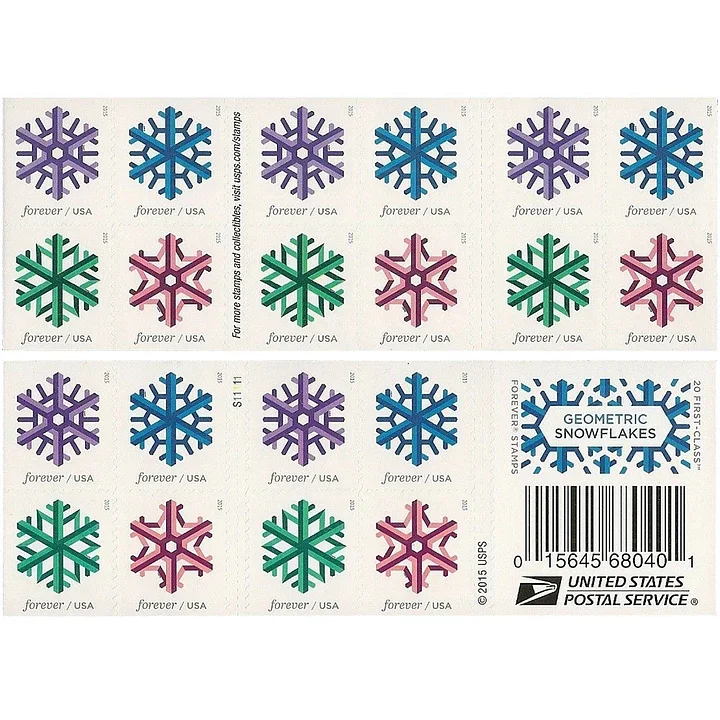
For a booklet comparison, the Geometric Snowflakes listing provides another issue to inspect. Its original booklet format is documented in the USPS release. Recheck current options rather than assuming the available counts remain unchanged.
For any quantity, confirm the complete envelope's postage first. Different paper, photos, or decorations can change the mailing requirements. Buying more stamps is not a substitute for the finished-envelope check.
A short buying checklist
- Write down the total stamps still needed.
- Confirm the exact issue or issues pictured.
- Read the selected total count and physical unit description separately.
- Clarify inconsistent format labels before ordering.
- Confirm any mixed-pack allocations or substitutions.
- Check delivery terms and leave time to inspect the received supplies.
The Christmas mailing timeline helps you place that inspection before card assembly. Shipping estimates concern your supply order; the cards still need to be mailed afterward.
Inspect the supply order before starting the cards
Keep the order confirmation and any written clarification about units, complete booklets, issue allocation, and substitutions. When the package arrives, compare the named issues and total count with that agreement, and inspect the backing and units before peeling stamps. If the contents do not match, photograph what arrived and contact support with the order number before using the disputed supplies. This is an inspection checklist, not a claim about a refund entitlement or the authenticity of a particular shipment.
Store unused supplies dry and protected, and leave room in your schedule to resolve a discrepancy. Do not turn a shipping estimate into a guaranteed arrival date for your supplies or the holiday cards.
Common packaging questions
Does a 100-stamp order mean one sheet containing 100?
No. It states the total. Five complete 20-stamp booklets would also total 100, but the seller must confirm the physical units actually included.
Are four designs in one booklet a mixed pack?
Not necessarily. A single postal issue can contain multiple designs. A retailer's mixed pack instead needs its own description of the included issues and counts.
Is a mixed pack always cheaper or better for a small mailing?
No. Compare the total cost, usable designs, needed quantity, and any permitted substitutions. A larger pack can leave unnecessary leftovers even when its unit price is lower.
Does sheet or booklet packaging change the postage value?
Packaging alone does not set the denomination. Genuine unused domestic Forever stamps retain the applicable one-ounce letter value; your completed envelope must still qualify. Check the current USPS First-Class Mail requirements and letter preparation guidance. International mail and unusually shaped or heavier envelopes need a separate postage review.
ToolStamps is an independent stamp retailer and is not affiliated with or endorsed by the U.S. Postal Service. Review our trust and authenticity information; an official issue reference does not verify the contents or authenticity of a particular retail order.